
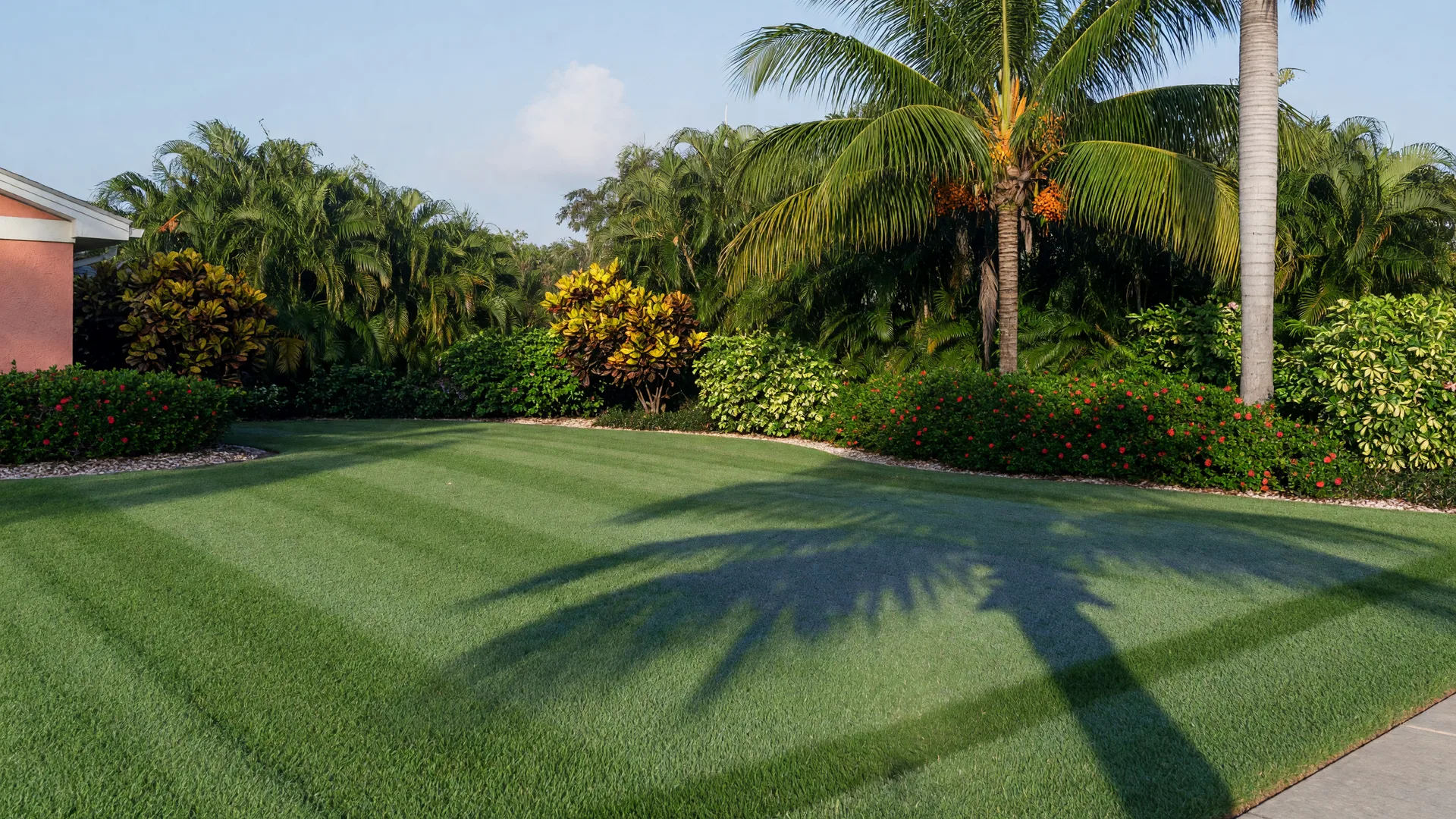
A South Florida lawn does not sleep through the winter the way lawns do up north. St. Augustine and Bahia grass keep some color and growth, but the cooler months call for a different rhythm. The University of Florida's IFAS extension has clear guidance for this stretch of the year, and following it protects the lawn through cold snaps and into spring. El césped del sur de la Florida no duerme durante el invierno como lo hacen los céspedes del norte. El césped San Agustín y el pasto Bahía conservan algo de color y crecimiento, pero los meses más frescos piden otro ritmo. La extensión IFAS de la Universidad de la Florida tiene una guía clara para este tramo del año, y seguirla protege el césped durante las olas de frío y hasta la primavera.
Mow tall and mow less often Corte alto y con menos frecuencia
UF/IFAS recommends keeping St. Augustine at about three and a half to four inches, and Bahia at three to four inches, year round. Taller grass tolerates cold and freeze stress better, and its deeper roots are more resilient. Growth slows in winter, so mow less often, and never remove more than about a third of the leaf blade in a single pass. UF/IFAS recomienda mantener el San Agustín en unas tres y media a cuatro pulgadas, y el Bahía en tres a cuatro pulgadas, durante todo el año. El césped más alto tolera mejor el frío y el estrés de las heladas, y sus raíces más profundas son más resistentes. El crecimiento se ralentiza en invierno, así que corte con menos frecuencia y nunca quite más de un tercio de la hoja en una sola pasada.
Water only when the grass asks Riegue solo cuando el césped lo pida
In the cooler months the lawn needs far less water. Instead of a fixed schedule, water only when the grass shows signs of wilt, usually when the leaf blades fold in half. When you do water, aim for about half to three quarters of an inch per event, in the early morning. A semi-dormant St. Augustine lawn may turn a little brown; that is normal, not a failure. En los meses más frescos, el césped necesita mucha menos agua. En lugar de un horario fijo, riegue solo cuando el césped muestre señales de marchitez, por lo general cuando las hojas se doblan a la mitad. Cuando riegue, apunte a cerca de media a tres cuartas partes de pulgada por evento, temprano en la mañana. Un césped San Agustín semiadormecido puede ponerse algo marrón; eso es normal, no un fracaso.
Skip the nitrogen until spring Omita el nitrógeno hasta la primavera
Late fall and winter are not the time for nitrogen, because it pushes tender new growth that cold weather can kill. If you fertilize at all before spring, UF/IFAS suggests a low-nitrogen, higher-potassium application in the fall, which strengthens cell walls and improves cold hardiness. Check your city or county rules, since many South Florida communities restrict winter fertilizing. El otoño avanzado y el invierno no son el momento del nitrógeno, porque empuja un crecimiento nuevo y tierno que el frío puede matar. Si fertiliza antes de la primavera, UF/IFAS sugiere una aplicación baja en nitrógeno y más alta en potasio en otoño, que fortalece las paredes celulares y mejora la resistencia al frío. Revise las reglas de su ciudad o condado, ya que muchas comunidades del sur de la Florida restringen la fertilización en invierno.
When a freeze comes Cuando llega una helada
Keep the grass at its tallest recommended height going into a cold night and leave it undisturbed. After a hard freeze, do not mow, walk on, or fertilize damaged turf; the roots and runners usually survive, and the lawn recovers on its own in spring. Patience after a freeze is a form of lawn care. Mantenga el césped a su altura máxima recomendada al entrar en una noche fría y déjelo sin tocar. Después de una helada fuerte, no corte, no camine sobre el césped dañado y no fertilice; las raíces y los estolones suelen sobrevivir, y el césped se recupera solo en primavera. La paciencia después de una helada también es una forma de cuidado del césped.
Why this matters for your home Por qué esto importa para su casa
A healthy lawn is part of how a home holds its value and how it feels from the street. Nanci reminds sellers that curb appeal starts in the yard, and she can point to landscaping professionals who know South Florida grass. For buyers, a well-cared lawn is a quiet sign of a well-cared home. Un césped sano es parte de cómo una casa mantiene su valor y de cómo se ve desde la calle. Nanci les recuerda a los vendedores que el atractivo exterior empieza en el jardín, y puede recomendar profesionales del paisajismo que conocen el césped del sur de la Florida. Para los compradores, un césped bien cuidado es una señal silenciosa de una casa bien cuidada.
Related guides Guías relacionadas
Nanci Gilbert, PA is a South Florida realtor who guides growing families, sellers, and buyers across Miami-Dade and Broward. Questions about this topic? She answers every message within one business day. Nanci Gilbert, PA es una realtor del sur de la Florida que guía a familias en crecimiento, vendedores y compradores en Miami-Dade y Broward. ¿Preguntas sobre este tema? Responde cada mensaje dentro de un día hábil.